When Home Is The Threat
What family trauma can do to the body, what the research can tell us, and what it still cannot

THE QUESTION
What happens when the place that is supposed to teach you safety teaches you to survive instead?
The harm is not always easy to name
Some childhood trauma is easy to name. A parent hits a child. A caregiver sexually assaults them. Violence erupts in the home.
Other forms are harder to explain because they happen inside relationships outsiders assume are safe: a sibling repeatedly attacks or strangles another sibling; one parent assaults a child while another minimizes it; both parents participate in abuse; a child is singled out as the problem; relatives are recruited into conflict; or a child reports being hurt and is told it never happened, they caused it, or their memory cannot be trusted.
The individual incidents matter. But so does the larger question: what happens to a developing nervous system when danger is not an event you escape from, but the environment you grow up inside?
IMPORTANT DISTINCTION
“Family scapegoat” is a useful description of a family role, not a psychiatric diagnosis. The strongest research measures the behaviors underneath the label: maltreatment, differential treatment, triangulation, invalidation, sibling victimization, coercion, neglect and polyvictimization.
Patterns that can sit underneath the scapegoat role
Physical, sexual or emotional abuse by a parent or caregiver
Repeated sibling aggression, bullying or severe violence
Witnessing domestic violence or being used inside adult conflict
Parental differential treatment, chronic favoritism or disproportionate punishment
Triangulation: being made messenger, ally, referee, secret keeper or target
Parentification: carrying emotional or practical responsibilities beyond a child’s role
Gaslighting, denial, minimization or blame after violence
Isolation, coercive control, threats, humiliation and chronic criticism
Multiple forms of victimization occurring together over time
Sibling violence deserves to be called violence
Sibling conflict is common. Repeated victimization is different. Prospective research following children into adulthood has linked frequent sibling bullying with later depression, anxiety, self-harm and suicidal behavior. In one UK birth cohort of more than 6,900 participants, children frequently bullied by siblings at age 12 had approximately twice the odds of several serious mental-health outcomes by age 18.
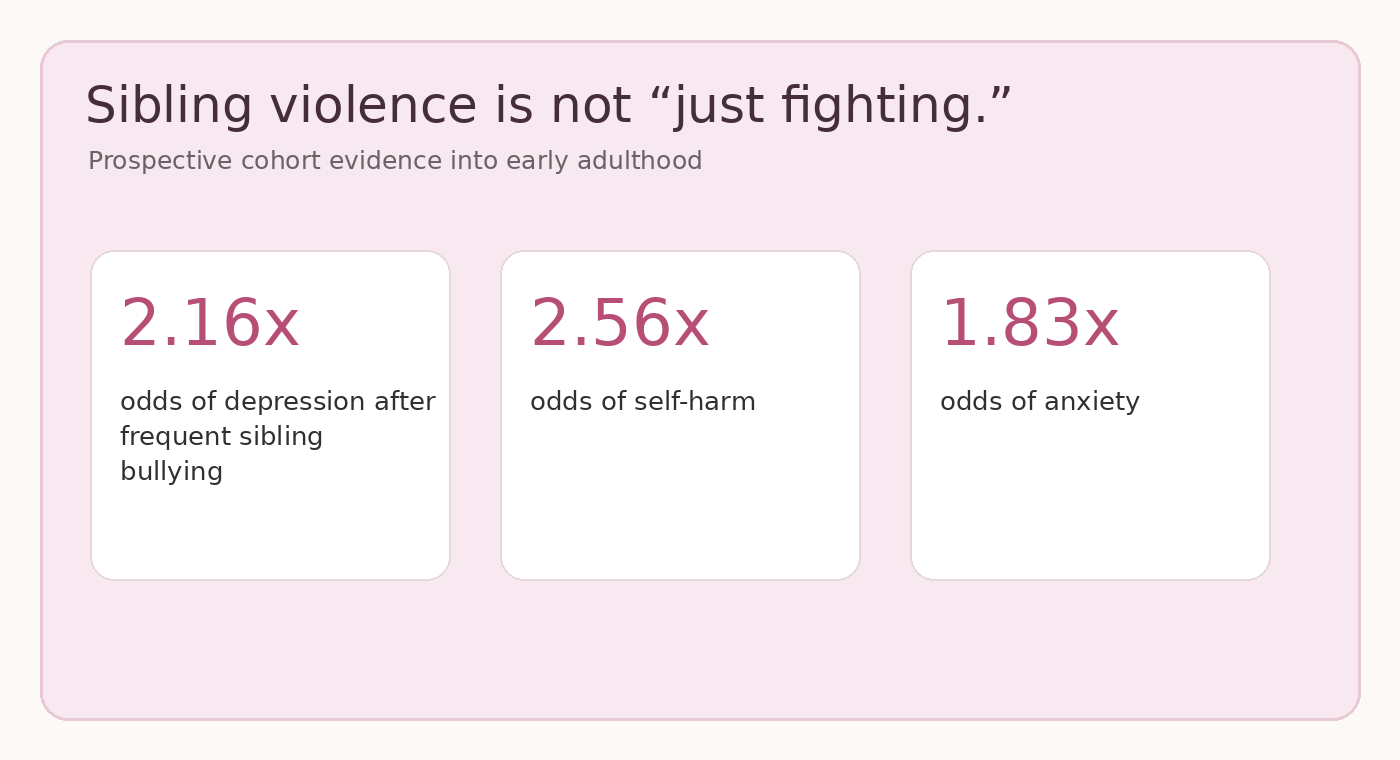
Bowes et al., Pediatrics (2014). Odds ratios describe group-level association, not an individual prediction.
Follow-up research to age 24 found sibling victims had increased odds of suicidal ideation and suicidal self-harm even after accounting for peer bullying and other childhood factors. Youth victimized both by siblings and peers showed some of the highest risks.
Strangulation belongs in a different category
Strangulation should not be softened into “roughhousing.” Pressure on the neck can interfere with blood flow and oxygen delivery and can produce serious neurological and vascular injury even when external marks are limited or absent. Most strangulation research concerns intimate-partner or sexual violence rather than sibling perpetrators, which is itself an important research gap. The physiology does not become harmless because the person applying the pressure is a sibling.
When the family system reinforces the harm
Trauma can become more complicated when the person responsible for protection becomes the source of danger, when another caregiver refuses to intervene, or when the family reorganizes itself around denying what happened.
Differential treatment
A 2025 network meta-analysis of 26 studies and 37,025 participants found greater parental differential treatment associated with depression, internalizing problems, aggression and rule-breaking. Children treated less favorably than siblings also showed higher levels of several psychological difficulties. Different treatment is not automatically harmful; children can legitimately need different parenting. The concern is persistent, disproportionate hostility, disbelief, punishment or exclusion.
Triangulation and parentification
Triangulation describes pulling a child into conflict between other family members. The child may become a messenger, ally, mediator, confidant or designated problem. Parentification is related but distinct: the child assumes emotional or practical responsibilities more appropriate for an adult. These patterns can force children to organize themselves around maintaining the family rather than developing safely within it.
The second injury: being told it did not happen
Research has strong categories for emotional abuse and invalidation but far weaker measurement for what happens after a child reports family violence and is collectively denied, blamed or portrayed as unreliable. That absence of a neat statistic does not mean the phenomenon is unimportant. It means the research language has not fully caught up with the lived pattern.
Trauma can become biological
The stress response is designed to keep us alive. Under threat, attention narrows, muscles prepare for action, stress hormones mobilize energy, sleep can become lighter, and immune and inflammatory processes can change. Research on childhood adversity and the HPA stress-response system is nuanced rather than uniform: a 2025 meta-analysis found associations with some cortisol measures, including flatter diurnal slope and blunted stress reactivity, while another 2025 meta-analysis found no overall difference in resting HPA-axis activity after maltreatment and substantial variation across studies. The evidence supports altered stress physiology in some contexts, not a single universal biological trauma signature.
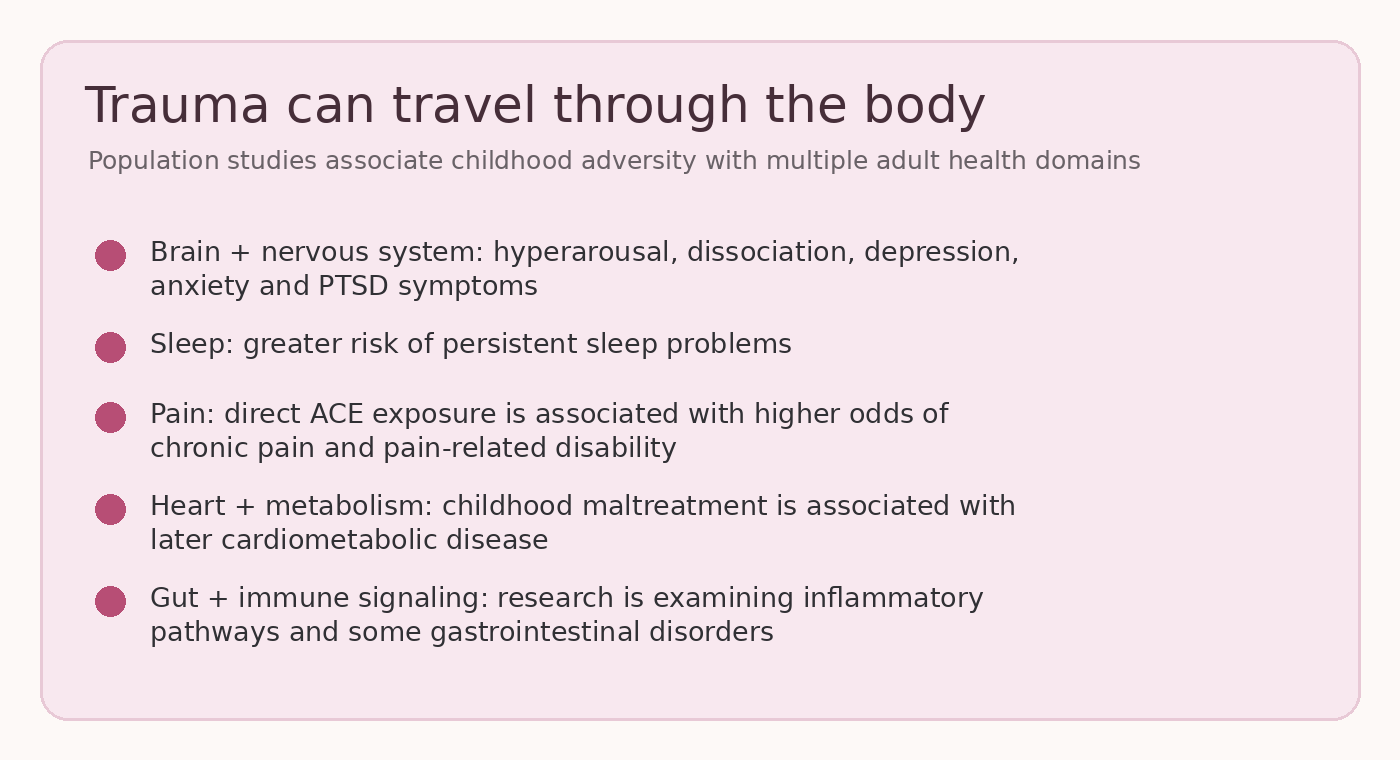
These are population-level associations. Trauma is one possible contributor, not a universal explanation for symptoms.
Chronic pain
A 2024 systematic review and meta-analysis covering 85 studies and 826,452 adults found direct adverse childhood experiences associated with higher odds of adult chronic pain. Childhood physical abuse was associated with about 50% higher adjusted odds of chronic pain. Risk increased with cumulative adversity; people reporting four or more ACEs had about 1.95 times the odds of chronic pain compared with people reporting none.
Sleep, heart health and the gut
Other research links childhood adversity with later sleep problems and cardiometabolic illness. Separate lines of research are examining inflammatory signaling and gastrointestinal disorders, including associations with some conditions such as irritable bowel syndrome. These findings should expand medical history, not replace medical evaluation. Trauma should never become a catch-all explanation for every symptom.
Why substances sometimes enter the picture
For some people, substance use can initially perform a function: quiet hyperarousal, create emotional distance, interrupt intrusive memories or help with sleep. That does not make substance use harmless, and it does not mean trauma explains every case. A large meta-analysis of 102 studies involving more than 900,000 participants found adverse childhood experiences associated with higher odds of several substance-use outcomes, including problematic alcohol use and illicit drug use. Population-level risk is not individual destiny.
RISK IS NOT DESTINY
Meta-analytic research finds ACE exposure associated with increased substance use and substance-use problems. But no population statistic can tell one survivor what they personally will do. Risk is shaped by later relationships, treatment, environment, genetics, opportunity, economic conditions and many other factors.
Suicide risk requires precision, not sensationalism
Childhood maltreatment and repeated sibling victimization are associated with higher risk of suicidal thoughts, self-harm and suicide attempts. But there is no responsible percentage that can tell an individual survivor, “this is your chance of attempting suicide.” Studies differ in age, population, definitions and exposures.
The useful conclusion is not that a survivor is destined for crisis. It is that people emerging from violent homes deserve serious support before a crisis occurs, and that sibling violence should not be dismissed simply because it happened between children in the same household.
IF THIS SECTION FEELS PERSONAL
In the United States, call or text 988 for the Suicide & Crisis Lifeline. Immediate danger requires emergency services. Research about elevated risk is not a prediction about any one person.
Survival strategies can look strange after danger ends
A person raised inside chronic threat may become exceptionally good at reading a room. They may notice a change in tone before anyone else, prepare several backup plans, struggle to ask for help, over-explain because their account was routinely challenged, freeze during ordinary confrontation yet function remarkably well in emergencies, or doubt their memory after years of being told their perception was wrong.
Some people dissociate. Others become hyper-independent. Some tolerate unsafe behavior far longer than outsiders understand. These patterns can become costly in adulthood, but many make more sense when viewed as adaptations rather than character defects.
A BETTER QUESTION
Instead of asking “What is wrong with this person?” trauma-informed care asks, “What did this response once protect them from, and is it still needed now?”
Where the research is still missing the story
1. Severe sibling violence is understudied
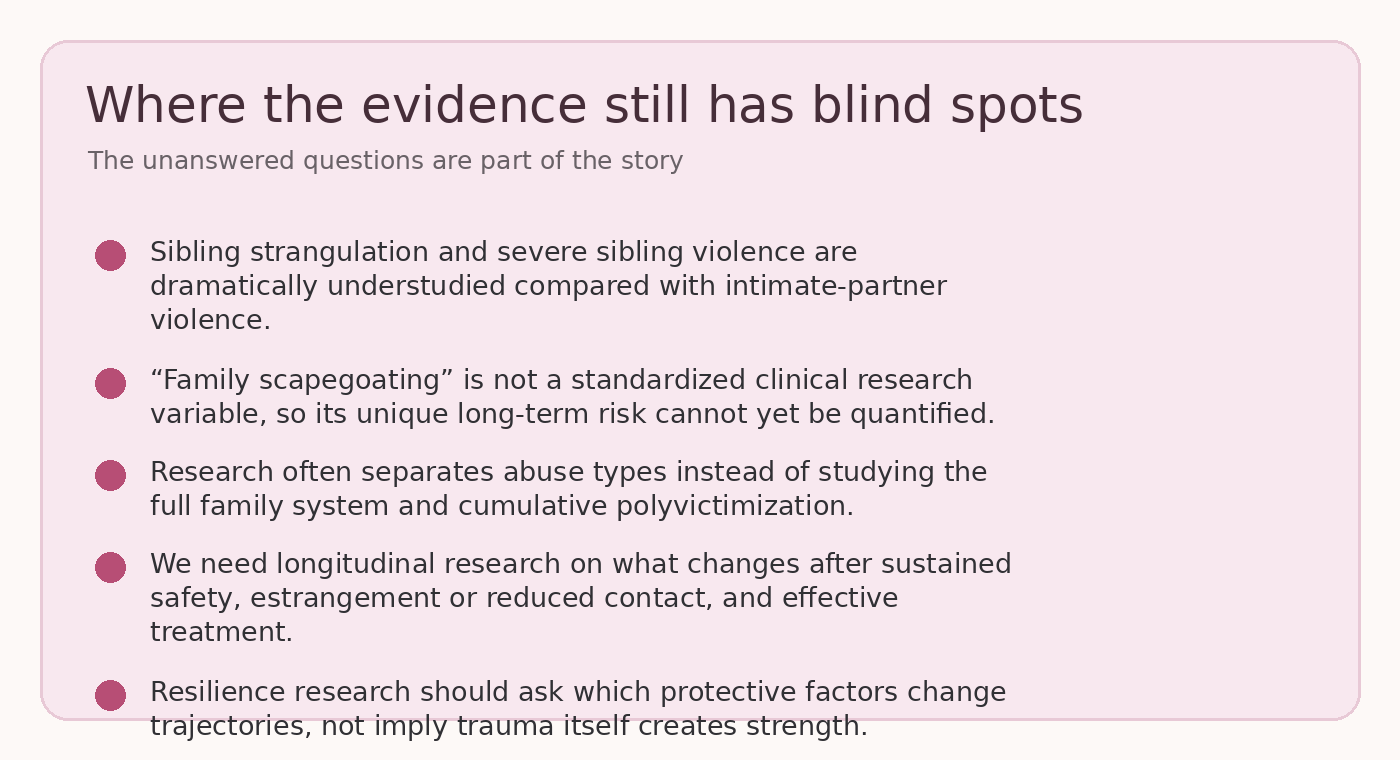
Sibling bullying research has grown, but severe sibling assault and sibling strangulation remain poorly characterized compared with intimate-partner violence. Researchers need better data on severity, frequency, parental response and long-term medical outcomes.
2. “Scapegoating” is poorly standardized
People describing family scapegoating often report disproportionate blame, exclusion, disbelief, differential punishment and relatives being recruited against them. Those components are studied separately. The pattern itself is not consistently defined or measured, so science cannot yet quantify its unique long-term effect.
3. Studies often split apart what families experience together
A child may experience physical violence from one parent, emotional abuse from another, sibling victimization, differential treatment and denial after disclosure. Studying each variable separately can miss the effect of occupying an unsafe position within the family system. Polyvictimization research is moving closer to this question, but much more is needed.
4. We need research after safety arrives
Trauma science is good at documenting risk. It should become equally interested in recovery. What happens to sleep, pain, stress physiology, relationships and substance use after two, five or ten years of sustained safety? What changes after effective treatment, stable housing, economic security, supportive relationships or reduced contact with persistently harmful relatives?
5. We should study the people who do unexpectedly well
Calling someone resilient is not enough. Researchers should ask which combinations actually change trajectories: one safe adult, education, economic independence, therapy, community, meaning-making, self-efficacy, physical distance from danger, or the ability to reject an inaccurate family narrative.
THE NEXT GENERATION OF QUESTIONS
What allowed you to get out? What helped your body recognize safety? What helped you trust your own perception again? What prevented addiction, suicide or repeated victimization? What helped you build relationships unlike the ones you grew up with? What can we change for the next child so survival requires less recovery?
Resilience is real. Trauma is not a gift.
A 2025 systematic review and meta-analysis of 203 studies involving 145,317 adults found childhood maltreatment generally associated with lower resilience across domains such as coping, self-esteem, emotion regulation, self-efficacy and well-being. Emotional abuse and neglect showed some of the strongest associations.
That finding matters because stories of highly capable survivors can accidentally turn suffering into a character-development program. Trauma can cost people something and they can still grow. Both can be true.
Resilience research points toward protective relationships, social support and other individual and environmental factors that can alter trajectories. Post-traumatic growth is also a legitimate research area, but growth and pain can coexist. A person can build a meaningful life and still carry a nervous system shaped by earlier threat.
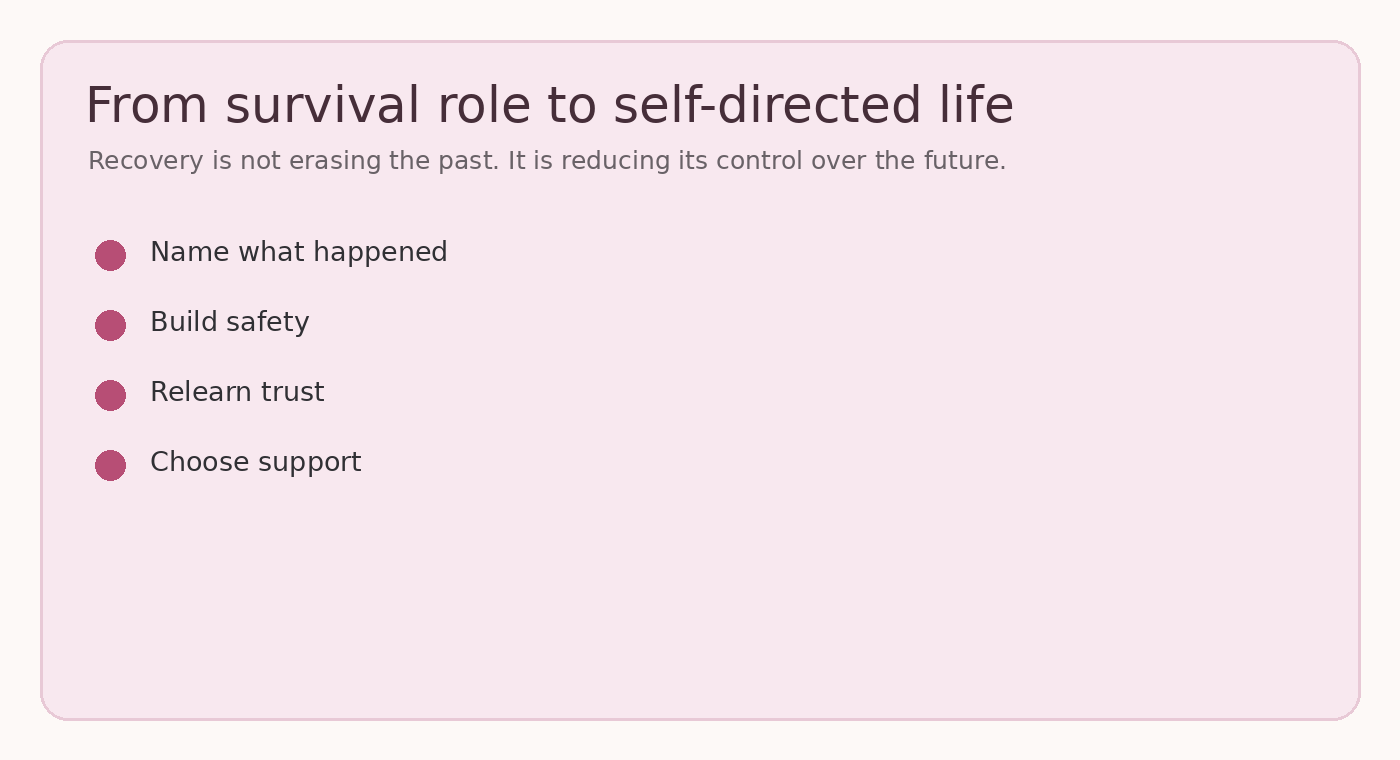
From scapegoat to GOAT
Stop using the family as the final authority on your reality
If people benefited from a version of events in which one person was always the problem, convincing everyone otherwise may be impossible. Recovery can include learning that truth does not require unanimous family approval.
Replace intensity with evidence
Documentation can matter: medical records, journals, contemporaneous messages and trustworthy witnesses. Internally, healing can also mean recognizing that an experience does not become unreal because someone refuses to validate it.
Build a nervous system that receives new information
Sleep, movement, regular food, medical care and safe relationships can support health, but they are not substitutes for PTSD treatment when PTSD is present. Current clinical guidance identifies trauma-focused psychotherapies, including Cognitive Processing Therapy, Prolonged Exposure and EMDR, among the treatments with the strongest evidence for PTSD. Treatment choice should be individualized with a qualified clinician.
Stop confusing hyper-independence with freedom
Leaving a harmful system can require extraordinary independence. Remaining completely unreachable forever is something different. Supportive relationships repeatedly appear as protective factors in resilience research. Strength can include learning how to choose safe people instead of learning how to need nobody.
Learn the difference between danger and discomfort
If disagreement once preceded violence, ordinary conflict can still register as threat. Recovery can involve learning more precise questions: Who is actually unsafe? Who merely disagrees? Who respects boundaries? Who apologizes and changes behavior? Who requires me to abandon myself to preserve the relationship?
Let anger become information instead of an identity
Anger can identify a violated boundary, motivate escape and make injustice visible. The goal is not to erase it. The goal is to keep the people who caused the original injury from permanently controlling the nervous system through it.
Build what the old system could not provide
Predictability. Safety. Financial independence. Education. Friendship. Quiet. Boundaries. Medical care. Creativity. Community. Work with meaning. A family you choose. A life in which telling the truth does not result in punishment.
THE REFRAME
The objective is not to become the person you would have been if nothing happened. Nobody can know that person. The objective is to stop organizing your future around the people who shaped your past. Maybe that is the real transition from scapegoat to GOAT: not proving them wrong, but building a life in which they are no longer the ones who get to define you.
How to read the numbers in this article
Most evidence here is observational. An odds ratio is not a personal probability, and an association does not prove that childhood trauma caused a particular illness. Genetics, socioeconomic conditions, later experiences, relationships, access to care, health behaviors and many other factors influence outcomes. Some studies rely on retrospective reports; others are prospective. The strongest conclusions come from converging evidence across multiple study designs, not from a single dramatic statistic.
Selected research
1. Bowes L, et al. Sibling bullying and risk of depression, anxiety, and self-harm: a prospective cohort study. Pediatrics. 2014. https://pubmed.ncbi.nlm.nih.gov/25201801/
2. Dantchev S, et al. Independent and cumulative effects of sibling and peer bullying on depression, anxiety, suicidal ideation and self-harm in adulthood. https://pubmed.ncbi.nlm.nih.gov/31616323/
3. Jiang Z, Yang Y, Chen B-B. Parental Differential Treatment of Siblings and Child Psychopathology: A Network Meta-analysis. 2025. https://pubmed.ncbi.nlm.nih.gov/40524095/
4. Jensen AC, et al. Sibling differences and parents’ differential treatment of siblings: A multilevel meta-analysis. Developmental Psychology. 2023. https://pubmed.ncbi.nlm.nih.gov/35758992/
5. Nelson S, et al. Adverse childhood experience is associated with an increased risk of reporting chronic pain in adulthood: systematic review and meta-analysis. 2024. https://pubmed.ncbi.nlm.nih.gov/38111090/
6. Karimov-Zwienenberg M, et al. Childhood trauma, PTSD/CPTSD and chronic pain: A systematic review. 2024. https://pubmed.ncbi.nlm.nih.gov/39213321/
7. Fares-Otero NE, et al. Child maltreatment and resilience in adulthood: a systematic review and meta-analysis. Psychological Medicine. 2025. https://pubmed.ncbi.nlm.nih.gov/40452373/
8. Zhang L, et al. Childhood Maltreatment and Its Long-Term Psychosocial Outcomes: An Umbrella Review of Meta-Analyses. 2025. https://pubmed.ncbi.nlm.nih.gov/41283227/
9. CDC. About Adverse Childhood Experiences (ACEs). https://www.cdc.gov/aces/about/index.html
10. 988 Suicide & Crisis Lifeline. https://988lifeline.org/
11. Niu L, et al. Association of childhood adversity with HPA axis activity in children and adolescents: a systematic review and meta-analysis. 2025. https://pubmed.ncbi.nlm.nih.gov/40157436/
12. Holochwost SJ, et al. Resting Hypothalamic-Pituitary-Adrenal Axis Activity in Childhood Following Maltreatment: A Meta-Analysis. 2025. https://pubmed.ncbi.nlm.nih.gov/40007054/
13. Hughes K, et al. Adverse childhood experiences and substance-use outcomes: systematic review and meta-analysis. https://pubmed.ncbi.nlm.nih.gov/37689565/
14. Stellpflug SJ, et al. Approach considerations for the management of strangulation in the emergency department. https://onlinelibrary.wiley.com/doi/full/10.1002/emp2.12711
15. U.S. Department of Veterans Affairs, National Center for PTSD. Overview of Psychotherapy for PTSD. https://www.ptsd.va.gov/professional/treat/txessentials/overview_therapy.asp