When Abuse Spreads Beyond Family
How communities can inherit an abuser’s story — and how to stop carrying it

The story can spread before the person ever speaks
A family can hurt someone in private. A community can make that harm public.
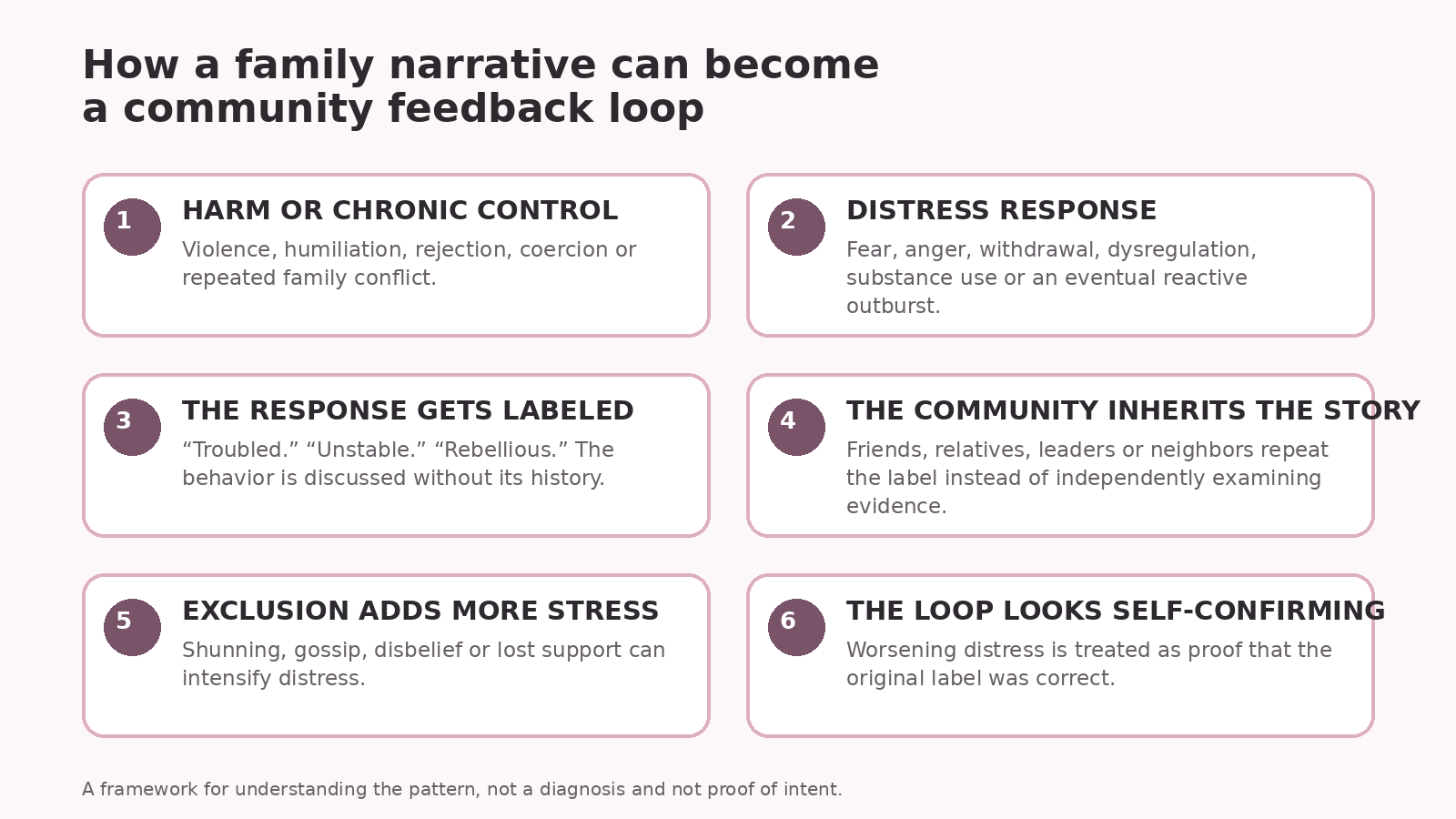
When a person grows up being described as “the problem,” the label may not stay inside the house. Relatives repeat it. Friends hear it. Religious leaders, coaches, neighbors or other trusted adults may encounter the family’s interpretation before they ever hear the targeted person’s account. Years later, ordinary evidence of distress — anger, fear, withdrawal, substance use, leaving the community, an eventual outburst — can be treated as proof that the old label was right.
Research does not give this entire pattern one neat clinical name. “Family scapegoating,” “smear campaign” and “community gaslighting” are common descriptions, but they are not standardized diagnoses. The science is stronger when we break the pattern into measurable pieces: child maltreatment, emotion dysregulation, negative reactions to disclosure, victim blaming, DARVO, ostracism, institutional betrayal, substance-use risk and the social costs of leaving high-demand communities.
Taken together, that evidence supports a difficult conclusion: harm does not always end when the original abusive interaction ends. The response of the surrounding social system can either interrupt the damage or extend it.
The story can spread before the person ever speaks
Families are social systems. They have reputations, alliances and narratives about who is responsible for conflict. Outside observers usually do not see years of interactions. They see fragments: who appears calm, who appears angry, who stayed in the community, who left, who uses substances, who has a leadership role, who is estranged.
That creates a basic information problem. A distressed person’s behavior can be real and concerning without proving the family’s explanation for why that behavior developed.
Meta-analytic research on maltreated children finds higher negative emotionality and greater emotion dysregulation on average than in nonmaltreated children. Another meta-analysis found childhood maltreatment associated with more emotion dysregulation, avoidance and emotional suppression. These are group-level associations, not a way to diagnose an individual. But they matter because observers can mistake the effects of adversity for evidence about a person’s character. [6][7]
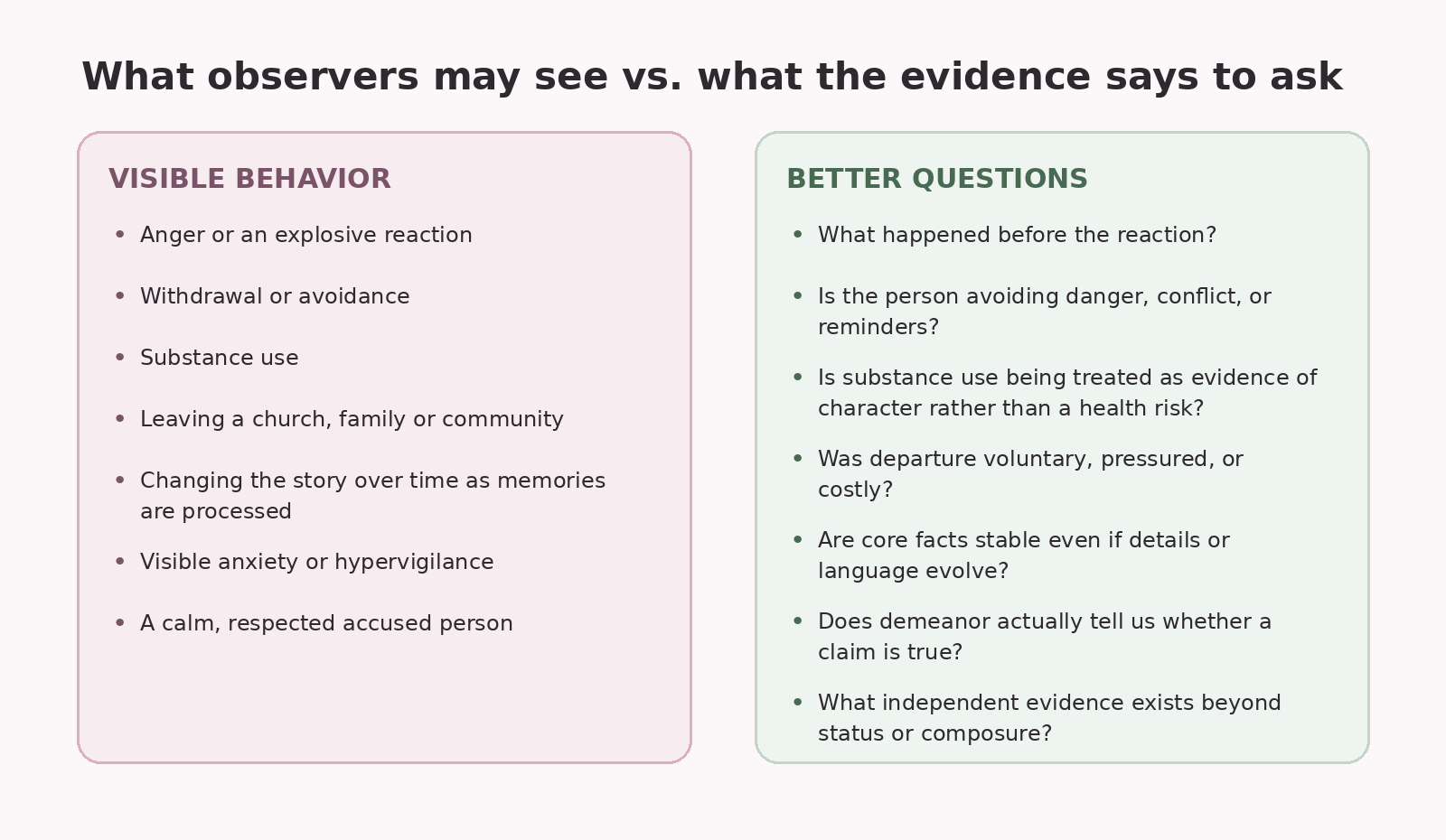
When the reaction becomes the evidence
There is a dangerous logical shortcut that can happen in families and communities: “If the person is angry, using drugs, panicking, withdrawing or acting erratically, then the negative story about them must have been true.”
The research does not support that shortcut. Childhood adversity is associated with later emotion-regulation difficulties, and difficulties regulating emotion are in turn associated more strongly with reactive than proactive aggression. Reactive aggression is not harmless and does not excuse hurting other people. But it is conceptually different from planned, instrumental aggression. Context matters. [7][8]
This is one reason a responsible assessment asks what happened before the visible reaction rather than beginning the story at the moment the distressed person finally became visible.
Substance use can become part of the loop
Substance use is another behavior that communities can moralize instead of investigate. A 2023 meta-analysis of 102 studies involving 901,864 participants found that adverse childhood experiences were associated with higher odds of smoking, problematic alcohol use, heavy alcohol use, cannabis use and illicit drug use. The pooled odds ratio for illicit drug use was about 1.70; for problematic alcohol use, about 1.81. [9]
Those figures do not mean trauma causes addiction in every survivor, and substance use does not prove that someone was abused. They do show why “they use drugs, therefore they were always the problem” is scientifically backwards. Substance use can be one downstream risk among people exposed to early adversity.
Disclosure can create a second injury
What happens after someone tells another person about violence matters. A systematic review and meta-analysis of 51 studies examined social reactions to disclosures of interpersonal violence. Negative reactions were associated with worse psychopathology, and reactions involving controlling the survivor, distracting them or treating them differently were especially concerning. The authors cautioned that the evidence is correlational and does not prove that every negative response caused later symptoms. [1]
Other work has found that stigmatizing reactions to intimate-partner-violence disclosure — including blaming the victim and minimizing what happened — were associated with depressive symptoms and avoidance coping. This suggests that disbelief and stigma are not socially neutral responses. They can become part of the survivor’s recovery environment. [19]
DARVO can change what bystanders believe
DARVO stands for Deny, Attack, and Reverse Victim and Offender. It describes a response in which a person accused of wrongdoing denies the conduct, attacks the other person’s credibility and presents themselves as the true victim.
Experimental vignette studies show why this matters for communities. In one study, participants exposed to a DARVO response saw the victim as less believable, more responsible and more abusive, while judging the accused person as less abusive and less responsible. A follow-up experiment found that brief education about DARVO reduced some of those effects. A 2023 experiment likewise found that DARVO shifted judgments toward greater believability of the accused and lower believability of the victim. [2][3]
IMPORTANT LIMITATION
DARVO is a behavioral pattern, not a magic test for who is telling the truth. People who have actually been harmed can deny accusations or attack credibility too. The research supports watching for the tactic and checking evidence, not automatically deciding guilt from communication style.
Composure is not a credibility test
Communities often rely on demeanor. The calm, respected person seems credible. The upset person seems unstable. Or the reverse: observers expect a “real victim” to look visibly devastated and distrust someone who appears flat or controlled.
A systematic review of 25 studies concluded that emotional demeanor can influence perceived victim credibility, but the effect depends on context and much of the literature relies on student samples. A meta-analysis focused on adult rape complainants found that visibly distressed complainants were rated as more credible even though emotional demeanor is not a reliable indicator of honesty or accuracy. [4][5]
That is a major reason not to treat calmness, panic, tears, anger, flat affect or polished social status as a lie detector.
When the community starts carrying the family’s message
Once a negative story spreads, ostracism can create its own feedback loop. A systematic review of experimental ostracism research describes a “vicious circle” in which psychiatric symptoms can increase the chance of exclusion and exclusion can then aggravate psychological difficulties. A broader review describes longer-term ostracism as potentially contributing to alienation, depression, helplessness and feelings of unworthiness. [10][11]
This does not mean every estranged or unpopular person is a victim of abuse. It means that social exclusion can worsen distress, so worsening distress after exclusion should not be treated as proof that exclusion was justified.
Religious and high-demand communities add another layer of power
Faith communities can be profound sources of belonging, meaning and practical support. They can also create special risks when spiritual authority, family reputation and institutional loyalty become entangled with an abuse disclosure.
Recent research on child sexual abuse in religious organizations describes barriers involving spiritual and institutional power, the moral authority of leaders, shame, theological narratives and institutional reputation. In Australian national data analyzed in that work, many disclosures were delayed, and historical inquiries documented disbelief, minimization or inaction after some disclosures. These findings come from religious-organizational abuse research, not specifically from Utah or the Church of Jesus Christ of Latter-day Saints, so they should not be generalized to every faith community. [13]
Research specific to people raised in the Church of Jesus Christ of Latter-day Saints is much narrower. One 2024 study of 534 sexual and gender minority adults raised LDS found that stronger religiously based family expectations were associated with depression, particularly when authenticity was lower. Qualitative research with ex-Mormons in Utah has described existential distress during loss of faith, and a 2026 preprint spanning several high-demand traditions, including former LDS participants, reported mental-health costs associated with more difficult religious exits. These studies illuminate the possible cost of belonging and leaving, but they do not establish that LDS communities generally shun abuse survivors or people who do not serve missions. [16][17][18]
WHERE THE EVIDENCE STOPS
There is not strong population-level research that lets us quantify how often a Utah family’s negative characterization of one child spreads through an LDS congregation, how often non-missionary men are socially shunned, or how often respected church status causes abuse disclosures to be discounted. Those are legitimate research questions, but they should not be presented as established facts.
Utah has a concrete legal layer: reporting suspected child abuse
Utah law generally requires a person who has reason to believe a child is or has been abused or neglected to report it immediately to the appropriate authorities. The statute contains specific exceptions, including a clergy-confession exception under defined circumstances. It also states that when a clergy member receives abuse information from a source other than the perpetrator’s confession, the clergy member is required to report it; and clergy may report ongoing abuse even when information also came through confession. Utah also has a clergy-communications privilege in its Rules of Evidence. [14][15]
For a community, the practical lesson is simple: child-safety concerns are not merely reputation-management problems or pastoral disagreements. Reporting duties and professional safeguarding procedures matter.
When an outsider weaponizes a disclosure
A separate but related problem occurs when someone outside the family first acts as a confidant and later uses the disclosure as social ammunition. Research has not created a single category called “weaponizing trauma disclosures,” but pieces of the pattern are well studied: negative social reactions to disclosure, victim blaming, stigmatization, ostracism, betrayal by trusted systems and reputational attacks.
The injury can be practical as well as emotional. The survivor may become more reluctant to seek support, may narrow their social world, or may feel pressure to publicly prove private experiences. That creates a credibility trap: the more desperately someone tries to correct every rumor, the more their life can become organized around the rumor.
The answer is not to stop talking forever. It is to become more deliberate about who receives sensitive information and what you do when private information is misused.
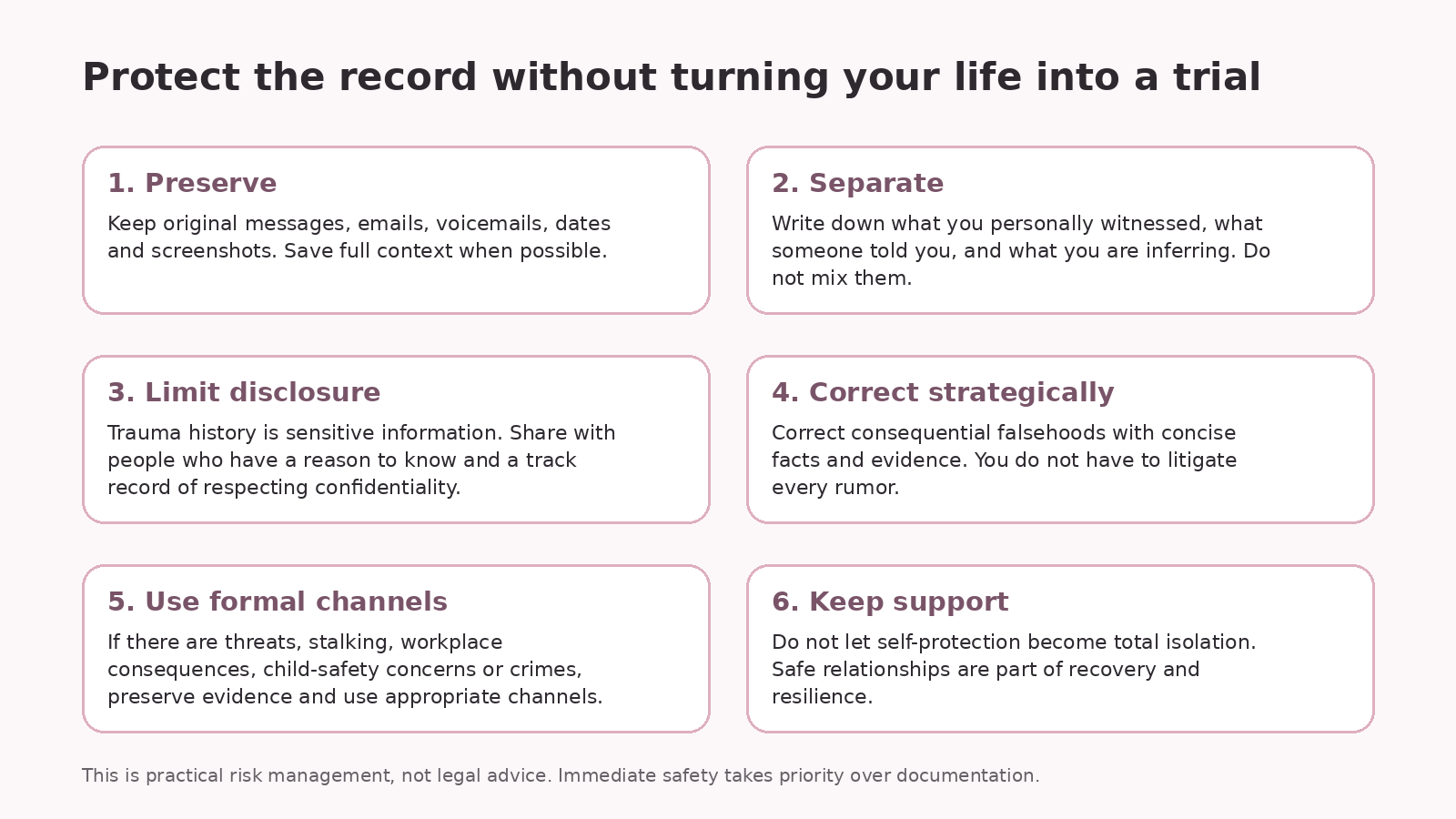
Protecting yourself from targeted social bullying
There is no single evidence-based protocol for a community smear campaign, so protection should be framed as risk management rather than a guaranteed strategy.
Preserve original evidence before responding. Keep complete message threads, emails, voicemails, dates, screenshots and relevant records. When possible, preserve context rather than isolated snippets.
Separate firsthand facts from interpretations. A clean contemporaneous record distinguishes “I saw this,” “this person told me this,” and “I think this means this.” That distinction improves your own clarity and makes later fact-checking easier.
Do not disclose trauma history indiscriminately. Trust is not established by someone sounding sympathetic once. Sensitive disclosures deserve the same caution as other private information.
Correct consequential falsehoods, not every opinion. If a false statement threatens safety, employment, housing, custody, professional standing or another concrete interest, a concise correction supported by records may matter. Trying to win every social argument can expose more private information and keep the conflict alive.
Use formal channels when the behavior becomes more than gossip. Threats, stalking, doxxing, workplace retaliation, child-safety concerns or alleged crimes should be documented and handled through appropriate professional or legal channels. Immediate safety comes before evidence collection.
Keep at least some safe connection. Ostracism research is a warning against allowing self-protection to turn into complete social isolation.
What a responsible community should do instead
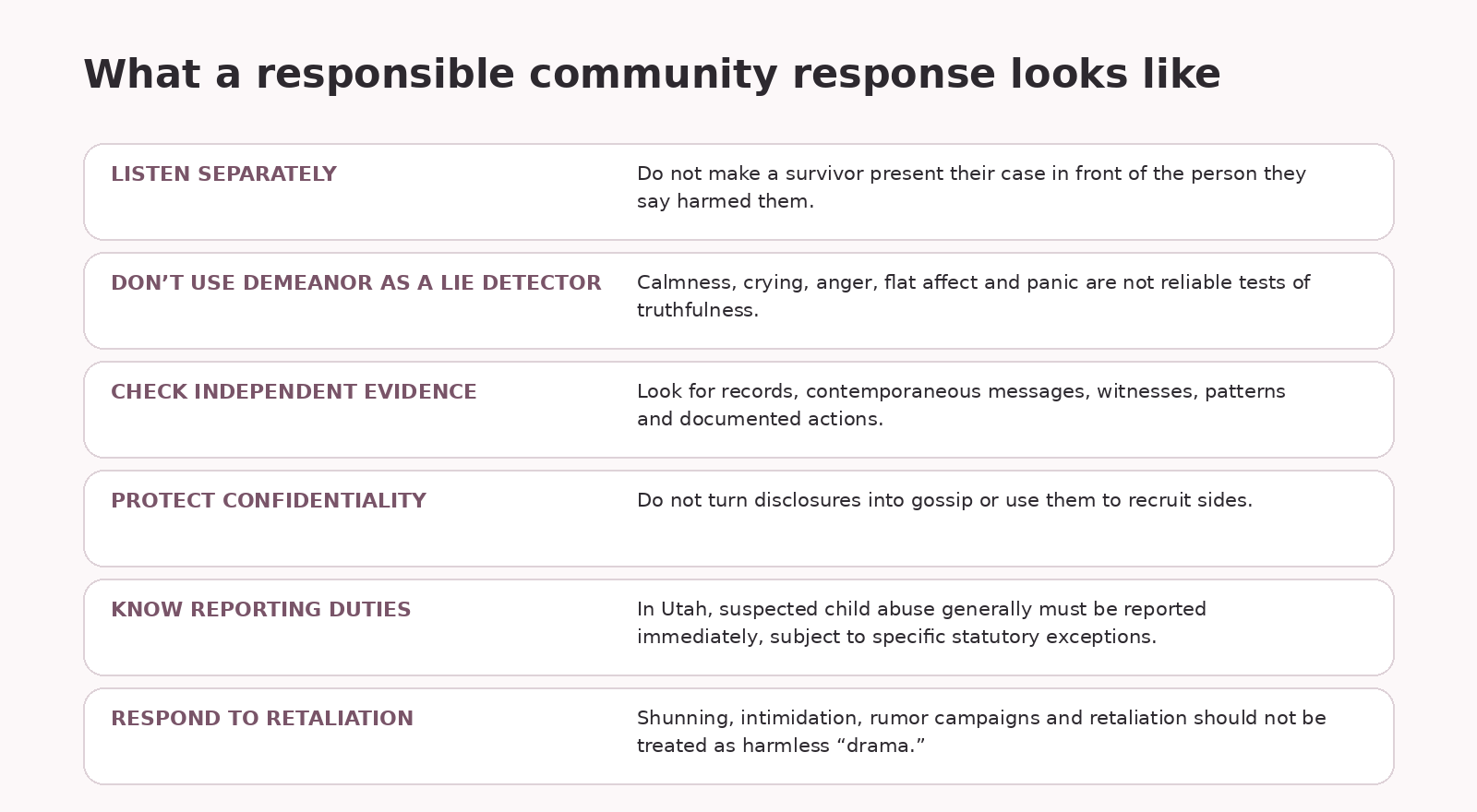
A responsible community does not have to become a courtroom. It does have to resist becoming an amplifier.
That means not treating reputation as evidence, not forcing someone to confront an alleged abuser publicly, not spreading a private disclosure as gossip, not using demeanor as a truth test and not punishing a person merely because they are distressed.
It also means taking allegations seriously without pretending that an allegation by itself proves guilt. The alternative to blind loyalty is not blind belief. It is a fair process: listen separately, preserve confidentiality, identify safety issues, examine independent evidence, follow reporting law and avoid retaliation.
Institutional betrayal — and what the alternative looks like
Researchers use the term institutional betrayal for failures by trusted institutions to prevent harm or respond appropriately after harm. The construct has been studied most extensively in settings such as universities and sexual violence. A 2026 study of campus sexual-assault survivors found that “institutional courage” — supportive and transparent institutional practices — moderated the relationship between institutional betrayal and trauma symptoms in that sample. The study was small (85 survivors at one public university), so it should not be treated as a universal effect. [12]
Still, the underlying principle is useful: institutions can choose transparency, accountability, accessible reporting, protection from retaliation and trauma-informed support instead of reflexive reputation defense.
Where research is still weak
This subject exposes several important gaps. Researchers need prospective studies of how a family’s characterization of one member spreads through schools, congregations, sports teams and neighborhoods. We need better measures of chronic scapegoating and community-level reputational harm. We need studies distinguishing justified boundary-setting from punitive ostracism. And we need to know more about what happens when a person discloses violence to a trusted friend who later publicly aligns with the accused person or redistributes the disclosure.
Utah-specific research is particularly thin. We do not have strong population estimates for how abuse allegations interact with religious status, mission expectations, family reputation, congregation leadership or religious exit in Utah communities. Anecdotes can identify hypotheses; they cannot substitute for those studies.
Researchers should also study recovery. What happens when a person finally moves into a community that does not already possess the family’s version of them? How quickly can reputation, self-concept, substance use, stress reactivity and social confidence change when the environment changes? Those questions matter because they shift the focus from “What is wrong with this person?” to “What happened around this person, and what changes when the environment becomes safer?”
The point is not to decide who is good and who is bad
A person can be traumatized and still behave badly. A parent can have legitimate concerns about an adult child and still have harmed that child. A survivor can remember details imperfectly. A respected community member can be falsely accused. A distressed person can tell the truth. A calm person can lie. None of these possibilities cancels the others.
That is precisely why communities should stop using social status, distress, religious conformity, substance use or reputation as shortcuts for evidence.
The better question is not: “Who looks like the troubled one?”
The better question is: “What happened, what can we independently verify, and are our actions making the situation safer or simply carrying someone else’s story forward?”
Research notes and source links
How to read the evidence: Most studies cited here show associations or experimental effects in defined samples. They do not prove that a particular person was abused, that a particular accused person is guilty, or that every religious or community setting behaves the same way. The article intentionally distinguishes directly studied findings from proposed community-level mechanisms that still need research.
Dworkin, Brill & Ullman (2019), Clinical Psychology Review — https://pubmed.ncbi.nlm.nih.gov/31260816/
Harsey, Zurbriggen & Freyd (2020), Journal of Aggression, Maltreatment & Trauma — https://doi.org/10.1080/10926771.2020.1774695
Harsey & Freyd (2023), Journal of Interpersonal Violence — https://pubmed.ncbi.nlm.nih.gov/37154429/
Van Doorn & Koster (2019), Aggression and Violent Behavior — https://doi.org/10.1016/j.avb.2019.03.007
Nitschke, McKimmie & Vanman (2019), Psychological Bulletin — https://pubmed.ncbi.nlm.nih.gov/31282696/
Lavi et al. (2019), Child Development — https://doi.org/10.1111/cdev.13272
Gruhn & Compas (2020), Child Abuse & Neglect — https://pmc.ncbi.nlm.nih.gov/articles/PMC12352122/
Smith et al. (2026), Emotion Regulation and Aggression: A Systematic Review and Meta-Analysis — https://pubmed.ncbi.nlm.nih.gov/41424362/
Zhu et al. (2023 online; 2025 issue), Child Abuse & Neglect — https://pubmed.ncbi.nlm.nih.gov/37689565/
Reinhard et al. (2020), European Archives of Psychiatry and Clinical Neuroscience — https://pubmed.ncbi.nlm.nih.gov/31586242/
Williams & Nida (2022), Current Opinion in Psychology — https://doi.org/10.1016/j.copsyc.2022.101353
Adams-Clark et al. (2026), Psychological Trauma — https://pubmed.ncbi.nlm.nih.gov/39636591/
Characteristics and Experiences of Disclosure of Child Sexual Abuse in Religious Organisations (2026) — https://pubmed.ncbi.nlm.nih.gov/42189449/
Utah Attorney General: Duty to Report Child Abuse or Neglect — https://attorneygeneral.utah.gov/duty-to-report-child-abuse/
Utah Rules of Evidence, Rule 503: Communications to Clergy — https://legacy.utcourts.gov/rules/view.php?rule=503&type=ure
Kim, Lefevor & Skidmore (2024 online; 2025 issue), Journal of Homosexuality — https://pubmed.ncbi.nlm.nih.gov/39028857/
Brooks (2020), Culture, Medicine, and Psychiatry: ex-Mormons in Utah — https://link.springer.com/article/10.1007/s11013-019-09646-5
Lisonbee et al. (2026 preprint), The Cost of Belonging—and Leaving — https://labs.sciety.org/articles/by?article_doi=10.31234%2Fosf.io%2F285rs_v2
Overstreet, Willie & Sullivan (2019), Journal of Interpersonal Violence — https://pubmed.ncbi.nlm.nih.gov/27296052/