Utah's Equality Gap Is Not Just a Ranking
What the numbers can cost women, why the gaps persist, and which solutions Utah can actually test
The headline: Utah performs poorly on multiple measures of women’s equality, but the more useful story is what sits underneath the rankings: pay, unpaid labor, childcare, leadership access, workplace culture, safety, and economic security.
The ranking gets attention. The consequences matter more.
A 2026 Utah State University review reports that Utah ranked 46th of 50 on U.S. News' 2025 gender-equality measure and 36th of 51 on the 2025 U.S. Women, Peace and Security Index. Those indexes measure different things, so neither should be flattened into a claim that Utah is simply “last for women.” They are signals that tell us where to look more closely.
And when we do, the story becomes much more concrete. Utah women are navigating a combination of lower earnings, unusually high unpaid-work demands, childcare constraints and limited representation at the top of many businesses. Those pressures do not affect every woman the same way, and some reflect personal choices. But statewide patterns can still create real economic tradeoffs.

What does the gap actually cost women?
1. Less money now, and potentially far less over a career
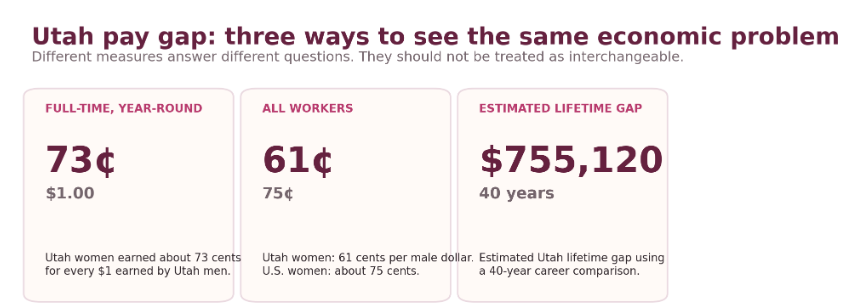
UWLP’s 2025 pay-gap update reports that Utah women working full-time, year-round earned about 73 cents for every dollar earned by Utah men, a gap of roughly 27%. When all workers are included, including part-time and seasonal workers, Utah women earned about 61 cents per male dollar, compared with about 75 cents nationally. UWLP also reports an estimated $755,120 lifetime earnings gap over a 40-year career comparison in Utah. That lifetime figure is an estimate, not a prediction for every woman, but it illustrates how annual differences can compound into less money available for savings, retirement, housing, emergencies and financial independence.
Source: Utah Gender Pay Gap: A 2025 Update (USU/UWLP)
2. Utah women are doing a striking amount of work that never appears on a paycheck
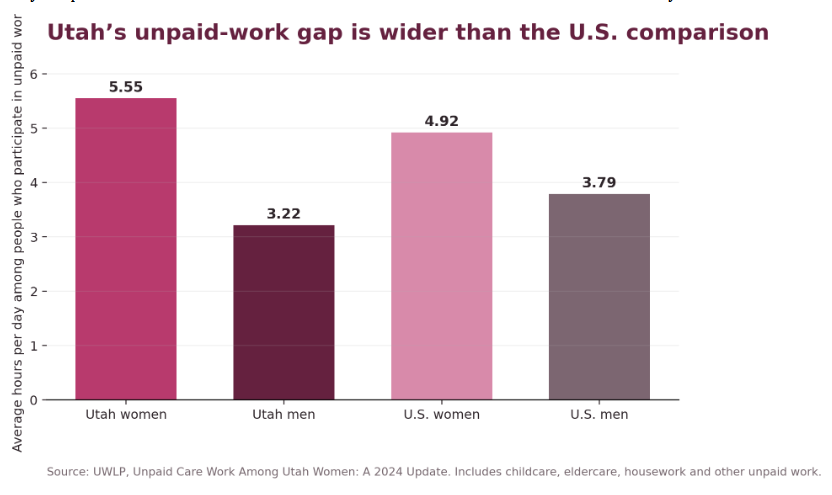
UWLP’s unpaid-care research reports that Utah women who participate in unpaid work average 5.55 hours per day, compared with 3.22 hours for Utah men. The report includes childcare, eldercare, housework and household management, and notes that women can also carry the less-visible work of noticing, planning, scheduling and organizing family needs. The important point is not that caregiving is inherently negative. Many women value it deeply. The problem appears when the amount of unpaid work leaves less time or flexibility for paid work, education, rest, advancement or a woman’s own economic security.
Source: Unpaid Care Work Among Utah Women: A 2024 Update (USU/UWLP)
3. Childcare can become an employment decision, not just a family expense
A 2026 UWLP research summary says Utah families struggle to find childcare that is accessible, affordable and high quality. The consequences reach the labor market: some parents reduce their work hours or leave the workforce when care does not work for their family. That matters especially in a state where many households rely on two incomes. It also means a childcare shortage can quietly become a career interruption, lost wages or reduced advancement for the parent who scales back work.
Source: Childcare: What Utahns Need to Know (UWLP, June 23, 2026)
4. The leadership pipeline narrows sharply at the top
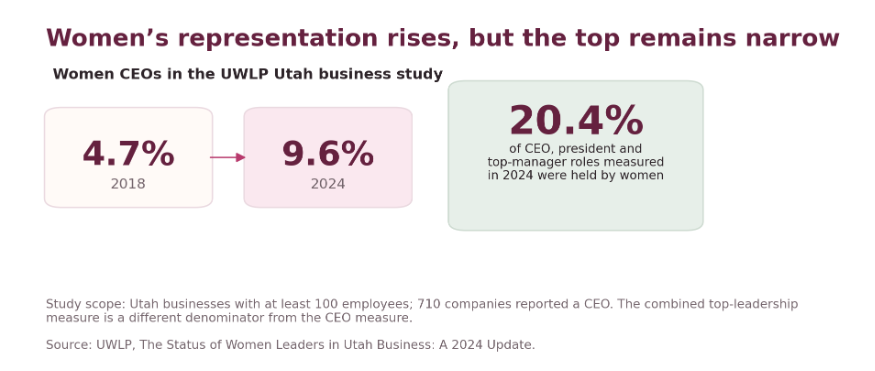
Women’s representation in Utah business leadership has improved, but the top remains disproportionately male. In UWLP’s 2024 study of Utah businesses with at least 100 employees, 68 of the 710 companies reporting a CEO had a woman CEO, or 9.6%. Across CEO, president and top-manager categories, women held 20.4% of the positions measured. That was a substantial improvement from earlier UWLP studies, which is important context, but it also shows how much representation changes as the lens moves from participation in the workforce to control and decision-making at the top.
Source: The Status of Women Leaders in Utah Business: A 2024 Update (USU/UWLP)
A useful distinction: A statewide pay gap is not proof that an employer pays a woman less than a man for identical work. It combines many forces, including occupation, hours, seniority, parenthood, industry, career interruptions and potential discrimination. That is exactly why employer-level and job-level data matter.
There is also a well-being question, but it needs careful wording
Utah also has serious mental-health challenges, and the gender difference is measurable. Using 2023 Utah Department of Health and Human Services data, UWLP reported that 32.5% of Utah women said a health professional had ever told them they had a depressive disorder, compared with 19.5% of Utah men. The same report notes that 29.9% of Utah adults were living with any mental illness in the national data it reviewed. None of this proves that Utah’s gender-equality gap caused those conditions. Economic stress, discrimination, caregiving load, safety, social isolation and many other factors can intersect with mental health. The responsible conclusion is that these systems deserve to be studied together, not that one ranking explains an individual woman’s depression or anxiety.
Source: Utah Women and Mental Health: A 2025 Update (USU/UWLP)
So what could Utah actually do?
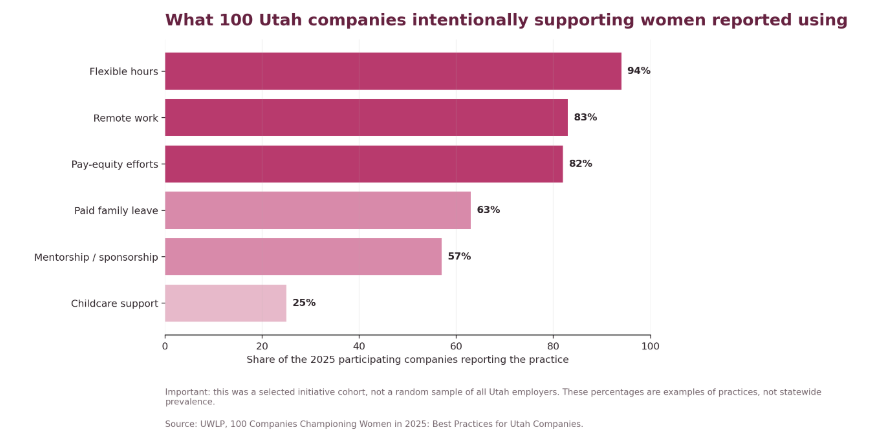
The encouraging part is that the possible responses are not purely theoretical. Utah employers are already using many of them. A 2025 review of the 100 companies participating in the state-linked “100 Companies Championing Women” initiative found flexible hours at 94%, remote-work options at 83%, pay-equity efforts at 82%, paid family leave at 63%, mentorship or sponsorship at 57%, and childcare support at 25%. This was a selected initiative cohort, not a random sample of Utah employers, so the percentages are not statewide prevalence estimates. They are useful as a menu of practices being used by organizations intentionally trying to recruit, retain and advance women.
Make pay differences visible
Employers can examine starting pay, raises, promotions and compensation within comparable roles rather than relying on one statewide wage number. Structured pay scales, regular audits and compensation studies were among the approaches reported by Utah companies in the 2025 initiative.
How to know if it works: Track adjusted and unadjusted pay differences, starting salaries, raises and promotion rates by comparable job group.
Design work so parenthood does not automatically derail a career
Flexible hours, remote options where the job allows them, phased returns after leave, professional part-time roles and paid family leave can give workers more ways to remain attached to their careers during caregiving-intensive years.
How to know if it works: Track retention after parenthood, promotion rates, use of leave and whether flexible workers continue to receive advancement opportunities.
Treat childcare as workforce infrastructure
Utah can examine not only the number of childcare slots but whether care is affordable, geographically available and open during the hours parents actually work. Utah already operates childcare-assistance programs for eligible families, while the 2026 UWLP research identifies broader access and affordability problems.
How to know if it works: Track childcare cost as a share of income, supply by county and work schedule, maternal labor-force participation and reductions in work hours tied to care.
Build a leadership pipeline before the executive opening appears
Mentorship, sponsorship, stretch assignments, leadership development and broader candidate searches can change who is prepared and visible when senior positions open.
How to know if it works: Track representation at each management level, promotion velocity, high-visibility assignments and retention of women with leadership potential.
Use Utah institutions as transparent test beds
Public agencies and willing large employers can publish consistent workforce measures, test interventions and report whether they actually change outcomes. This avoids pretending that every popular policy works equally well in every workplace.
How to know if it works: Publish baseline measures first, define the intervention, then report the same measures over time.
Who has a lever?
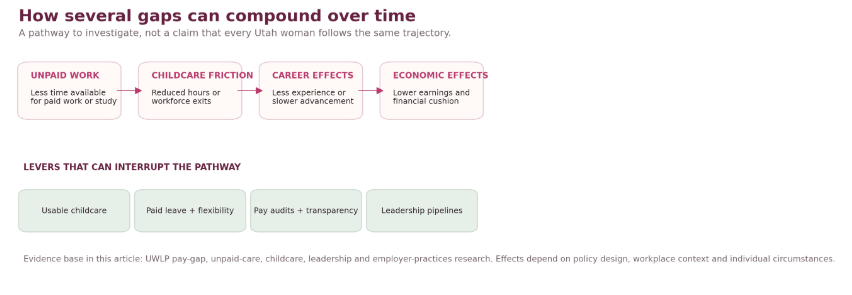
No single Utah official, employer or family controls these outcomes. Employers control many compensation, promotion, scheduling and leave practices. State policymakers influence childcare systems, public-employer practices and labor policy. Public agencies control their own workforce data and employment practices. Families make private decisions about paid and unpaid work. The useful question is not who to blame for a ranking. It is which institution controls which lever, and whether changing that lever measurably improves women’s options and outcomes.
The next questions She Files Utah should investigate
What happens to Utah women’s earnings before and after motherhood, and how does that compare with Utah fathers?
Which Utah counties have the largest mismatch between childcare supply, price and the hours parents actually work?
Which Utah public employers publish enough salary and promotion data to examine advancement by gender?
Which Utah industries have the widest gaps between women’s workforce participation and women’s representation in leadership?
Which employer policies show measurable retention or advancement effects rather than simply appearing on a benefits list?
The bottom line: Utah’s equality gap is not interesting because a ranking says the state is doing poorly. It is interesting because several measurable systems can compound: what women earn, how much unpaid work they carry, whether childcare allows them to stay in paid work, and whether career pathways remain open as their lives change. The strongest response is not another slogan. It is better Utah-specific data, targeted interventions and public measurement of whether those interventions work.
FACT-CHECK NOTE | Figures in this brief were rechecked against the linked Utah State University/UWLP publications and Utah Department of Workforce Services pages in September 2026. Where a source reports a survey, selected cohort or estimate, the article labels it as such rather than treating it as a statewide causal finding.
Sources & further reading
USU/UWLP, 2026 Status of Utah Women and Girls
USU/UWLP, Utah Gender Pay Gap: A 2025 Update
USU/UWLP, Unpaid Care Work Among Utah Women: A 2024 Update
USU/UWLP, Childcare: What Utahns Need to Know (2026)
USU/UWLP, The Status of Women Leaders in Utah Business: A 2024 Update
USU/UWLP, 100 Companies Championing Women in 2025
USU/UWLP, Utah Women and Mental Health: A 2025 Update
Utah Department of Workforce Services, Child Care Assistance