Maternity Care Access
In Utah, maternity care depends partly on your ZIP code
Utah performs better than the national average on some maternity access measures, but county-level gaps remain. The important question is not whether the state is doing well or badly overall. It is whether pregnant and postpartum people can actually reach care where they live.

A statewide average can hide a local access problem
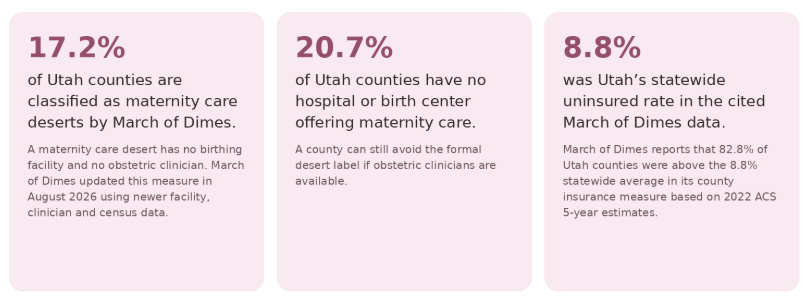
March of Dimes classifies maternity care access county by county using birthing facilities, obstetric clinicians and insurance coverage. Its Utah maternity-care-desert page, updated in August 2026, classifies 17.2% of Utah counties as maternity care deserts. Separate facility data show that 20.7% of Utah counties have no hospital or birth center offering maternity care.
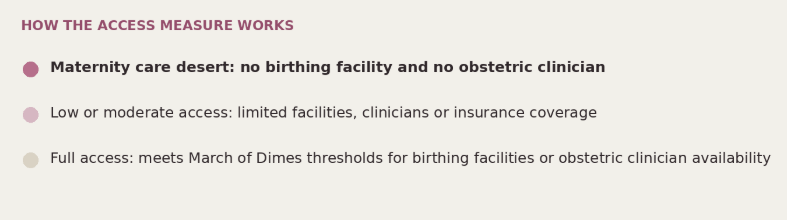
Those figures are not contradictory. The formal maternity care desert definition requires both no birthing facility and no obstetric clinician. A county can lack a hospital labor and delivery unit while still having clinicians who provide some pregnancy care. That distinction matters because a map of hospitals alone does not tell the entire access story.
Utah looks better than the nation on one measure, but the national baseline is weak
The 2026 national March of Dimes report says 34.6% of U.S. counties are maternity care deserts. Utah's 17.2% share is lower. That is useful context, but it should not become a reason to ignore local gaps. A county without nearby obstetric services can mean substantially longer travel to labor and delivery and can complicate timely access to prenatal, delivery and postpartum care.
The broader national maternal-health picture also remains concerning. The CDC reported 649 maternal deaths in the United States in 2024, a rate of 17.9 deaths per 100,000 live births. The rate was not statistically different from 2023. International comparisons published by the Commonwealth Fund have found that the United States has a substantially higher maternal mortality rate than other high-income countries studied, while also having fewer maternity-care providers and weaker postpartum supports in several areas.
Insurance is part of access, but coverage does not create a provider
Utah Medicaid currently provides eligible pregnant women full medical coverage through pregnancy and for 12 months after the pregnancy ends. Covered services include pregnancy and postpartum care, behavioral health care, doula services, breast pumps, education, care coordination and home visits. That extended postpartum window is important because health risks do not end at delivery.
Coverage still solves only one layer of access. Insurance can pay for care, but it cannot shorten a long drive, reopen a labor and delivery unit, or place an obstetric clinician in a county that does not have one. The system has to be measured in layers.

What should Utah measure next?
A useful accountability dashboard would go beyond a single statewide maternal-health score. It would track county-level travel time to labor and delivery, obstetric clinician availability, births occurring outside a resident's home county, prenatal appointment availability, postpartum follow-up, Medicaid continuity, and closures or openings of labor and delivery units.
Reader action: Check the maternity-care classification for your county and compare it with the nearest labor and delivery facility. If the distance is significant, ask your health system, county health department and state health officials what emergency transfer plan, prenatal access and postpartum follow-up exist for residents in your area. For Medicaid questions, use Utah Medicaid's current pregnancy and postpartum eligibility pages rather than relying on older coverage rules.
Utah, the United States and other high-income countries are measuring different parts of the same problem
Utah's county data show where facilities and clinicians are missing. The national data show that maternity care deserts remain widespread across the United States. International comparisons add another lens: other high-income countries generally report lower maternal mortality and more structured postpartum supports. None of those comparisons proves that one policy causes one outcome. Together, they identify concrete systems worth measuring: workforce, geography, coverage and continuity after birth.
Resources & Original Sources
CDC National Center for Health Statistics: Maternal Mortality Rates in the United States, 2024
Commonwealth Fund: U.S. maternal mortality international comparison
Before You Go
A maternity-care system is not accessible simply because services exist somewhere in the state. The practical test is whether people can reach the right care, at the right time, before, during and after pregnancy. Utah has measurable strengths compared with the national county average, and measurable gaps that remain visible once the data is broken down geographically.