When Housing Instability Hits Utah Women, the Numbers Tell Only Part of the Story
Utah’s 2026 one-night homelessness count moved in the right direction. Annual service data still shows thousands of women navigating housing instability, and for more than a thousand of them, domestic violence was part of the record.

Editorial illustration: housing instability can look like paperwork, temporary moves, caregiving and uncertainty, not only street homelessness.
Utah’s 2026 Point-in-Time (PIT) count recorded 4,512 people experiencing literal homelessness on one night in January, down 1.6% from 4,584 in 2025. Unsheltered homelessness fell 9.7%, and chronic homelessness fell 6.7%, while sheltered homelessness increased slightly. State officials described the overall decline as the first year-over-year decrease in recent state history. [1]
That is meaningful progress. It is also one measurement. The PIT count is designed to answer a specific question on a specific night; it is not an annual census of every person who used homelessness services or everyone living in unstable housing. [2]
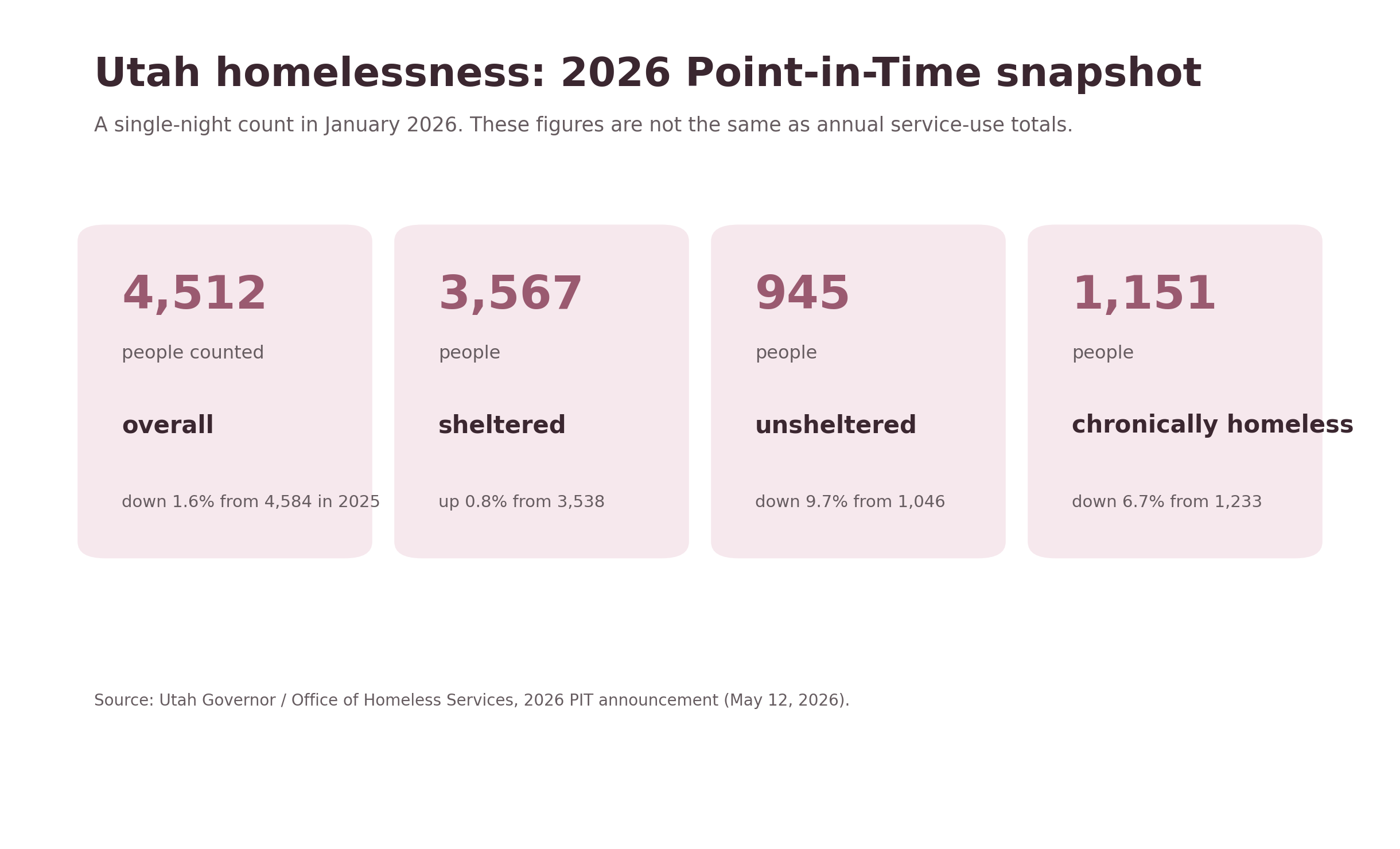
2026 Point-in-Time figures from Utah’s May 2026 announcement. [1]
The improvement and the warning can both be true
Utah’s annual homelessness dashboard combines several measures, including the Point-in-Time Count, Housing Inventory Count and System Performance Measures. The state explicitly cautions that the measures use different methods and answer different questions. Read together, they show both the size of homelessness on a particular night and how the response system is being used across the year. [2]
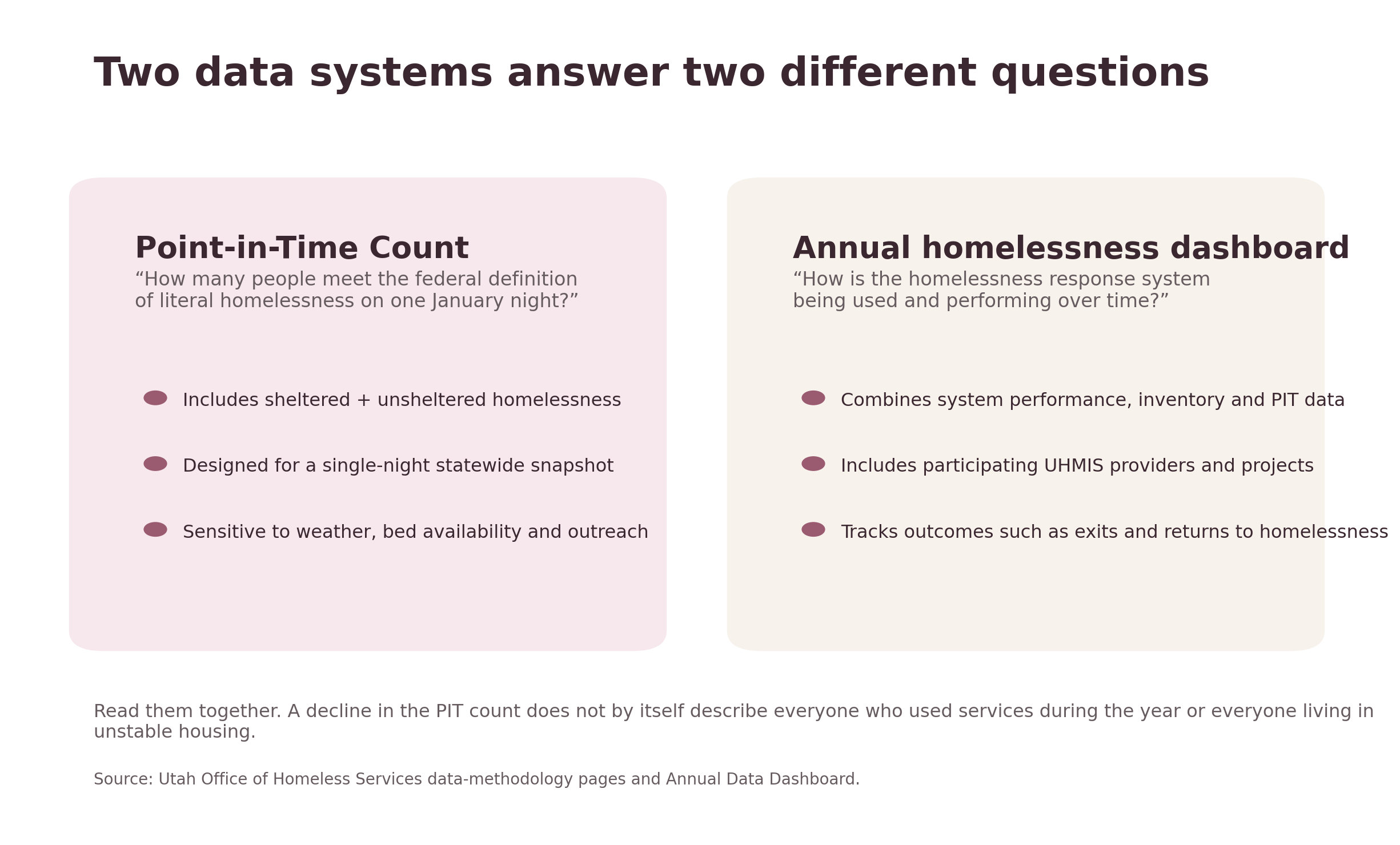
The PIT count and annual system data should not be treated as interchangeable. [2]
That distinction matters for women. A December 2025 Utah Women & Leadership Project (UWLP) research snapshot, drawing on Utah Office of Homeless Services data, reported that 30,578 people accessed homelessness services during 2025. Women accounted for 12,823 of them, or 41.9%. Among those women, 1,103 had experienced domestic violence and 329 were currently fleeing domestic violence when they sought help. [3]
Important denominator: The 30,578 annual service-use figure and the 4,512 PIT figure are not two estimates of the same thing. The first covers people who interacted with participating homelessness services during the year; the second counts literal homelessness on one January night.
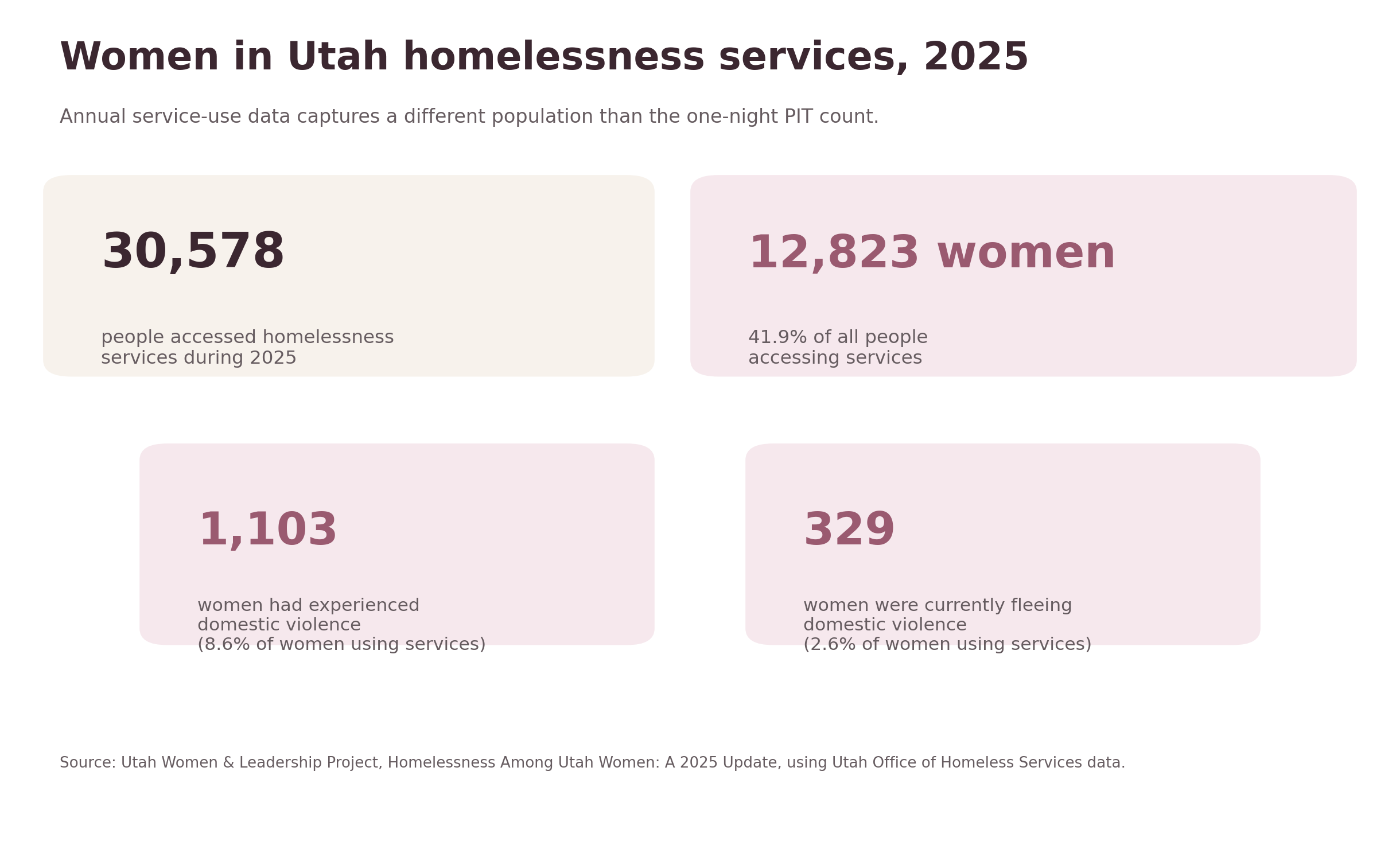
Annual 2025 service-use data from UWLP’s synthesis of Utah Office of Homeless Services data. [3]
Why a women’s lens changes the system map
A simple male-versus-female headcount cannot explain why a person lost housing or what kind of help will make housing stable again. In Utah’s 2025 service data, women reported a range of barriers to securing housing, including mental health disorders, chronic health conditions, physical and developmental disabilities, substance use and domestic violence. Those figures describe recorded barriers among people using services; they do not establish a single cause of homelessness for any individual. [3]
Broader research also shows why women can be underrepresented in conventional homelessness counts. Reviews from high-income countries describe “hidden homelessness,” including temporarily staying with friends or relatives, and note that women’s pathways into homelessness are often intertwined with intimate partner violence, poverty, caregiving and financial dependence. Those findings are not Utah prevalence estimates, but they explain why a one-night literal-homelessness count cannot capture every form of housing instability. [4]
What the evidence can and cannot show: The Utah data supports examining violence, economic pressure, health, disability and caregiving as parts of the housing-instability picture. It does not support saying that one gendered mechanism explains homelessness in Utah, or that domestic violence caused every housing crisis recorded in the service data.
What evidence says may help
Housing interventions for survivors of intimate partner violence have a growing evidence base, but it is not uniform. A 2022 systematic review of 34 controlled studies found the strongest evidence of benefit for mental health, intent to leave an abusive partner, perceived safety, and housing- and partner-related stress. The authors also found high risk of bias in many studies and called for stronger research, especially on long-term housing solutions. [5]
One of the better-studied approaches is Domestic Violence Housing First (DVHF). The model pairs survivor-driven, housing-focused advocacy with flexible financial assistance that can address practical barriers to safe housing. In a 24-month comparative effectiveness study involving five domestic violence agencies in one Pacific Northwest state, survivors receiving DVHF had greater housing stability and safety and lower depression, anxiety and PTSD symptoms than survivors receiving services as usual. [6]
That study strengthens the case for treating housing as part of a safety response rather than as a problem survivors must solve after everything else. It does not prove that every Utah community would see identical results, and the study was not a randomized statewide Utah trial. [6]
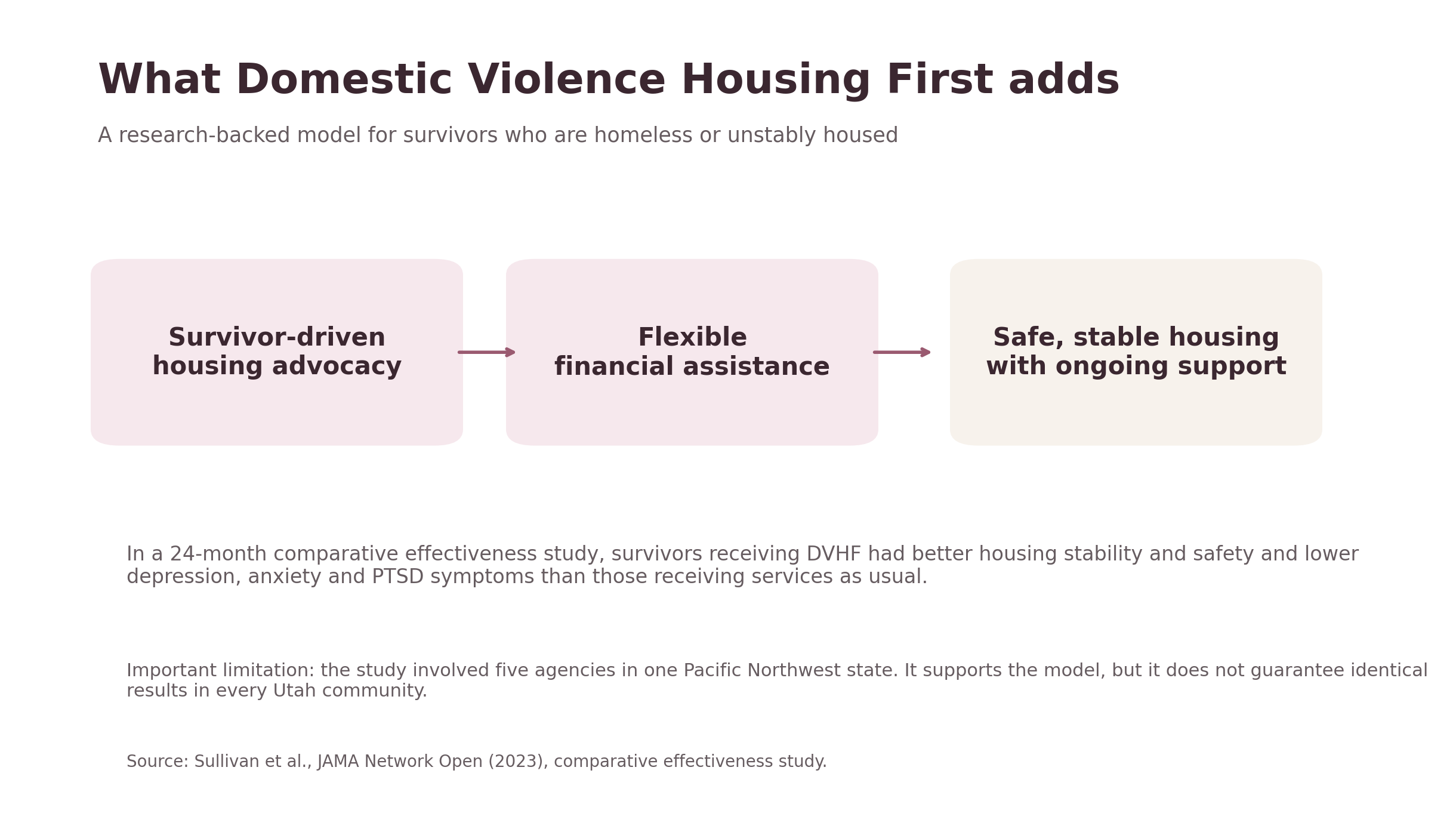
Domestic Violence Housing First combines housing-focused advocacy with flexible funding. [6]
Where Utah residents can look for accountability
For current statewide and local data, the Utah Office of Homeless Services Annual Data Dashboard is the most direct starting point. The state is divided into three Continua of Care and 13 Local Homeless Councils, which coordinate funding, data quality and housing and homelessness services at regional and local levels. [2][7]
For the broader housing system, Utah’s Division of Housing and Community Development publishes housing reports, the state strategic housing plan and federally required consolidated and annual action plans. Those sources can help residents ask concrete questions about prevention, affordable housing supply, service capacity and whether outcomes are being reported clearly enough to identify who is still cycling through crisis systems. [8]
If you need help now
Safety comes first. If someone is in immediate danger, call 911. Utah’s Department of Health and Human Services lists the Utah Domestic Violence Coalition 24/7 LINKLine at 1-800-897-5465 and directs survivors to local shelter, transitional housing and support services. A general article cannot assess an individual safety plan. [9]
What to watch next
The strongest measure of progress is not whether one annual headline goes up or down. Utah’s stated system goal is to make homelessness rare, brief and non-recurring. That makes several follow-up questions especially useful: How long are people homeless? How quickly do they move into permanent housing? How often do they return to homelessness? And can those outcomes be examined by sex, family status and domestic-violence history without compromising survivor privacy? [2]
For women fleeing violence, the central question is even more concrete: can a survivor reach safe, stable housing without repeatedly cycling through shelter, unsafe temporary arrangements or financial crises? The current Utah data identifies the overlap. Better outcome tracking can show whether the system is actually interrupting it.
Before you go… A statewide number can improve while individual women are still carrying impossible choices. The most accurate picture comes from reading the one-night count, annual service data and survivor-specific evidence together — and being precise about what each source can actually tell us.
Sources & research notes
[1] Utah leaders announce homelessness declines for first time in years — May 12, 2026 PIT announcement: 4,512 overall; 945 unsheltered; 1,151 chronically homeless; 3,567 sheltered.
[2] Utah Office of Homeless Services — Annual Data Dashboard — Methodology and annual statewide/local system measures.
[3] Blackburn & Madsen — Homelessness Among Utah Women: A 2025 Update — UWLP Research Snapshot No. 65; 2025 Utah service-use and domestic-violence figures.
[4] Andermann et al. — Evidence-informed interventions and best practices for women experiencing or at risk of homelessness — Scoping review with gender and equity analysis, including hidden homelessness and gendered pathways.
[5] Yakubovich et al. — Housing interventions for women experiencing intimate partner violence — Lancet Public Health systematic review of 34 controlled studies.
[6] Sullivan et al. — Domestic Violence Housing First and survivors’ housing stability, safety and well-being over 2 years — Comparative effectiveness study of DVHF vs. services as usual.
[7] Utah Office of Homeless Services — State Organization — Three Continua of Care and 13 Local Homeless Councils.
[8] Utah Division of Housing & Community Development — Reports — State housing reports, strategic plan and consolidated/annual action plans.
[9] Utah DHHS — Domestic violence resources — State-listed shelter, transitional housing and support resources.